
How Long Is Marijuana Detected in Urine? THC Detection Times, Tests & Key Factors
Published on: March 9, 2026
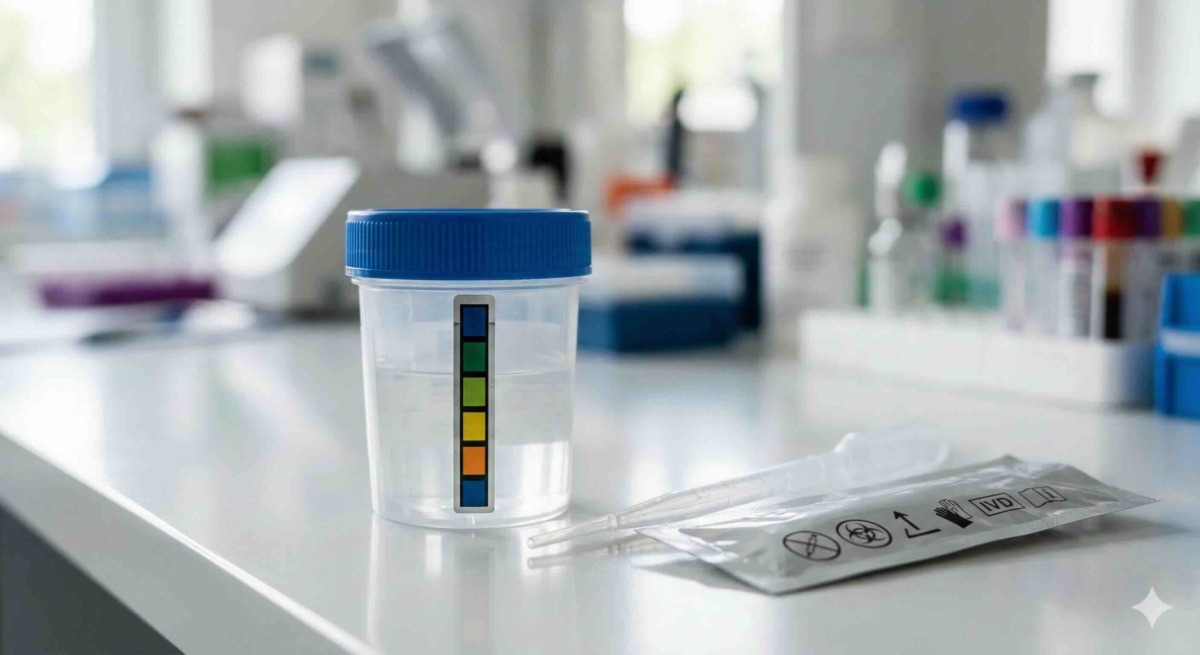
THC-COOH — the primary metabolite of cannabis — is a fat-stored compound that urine drug tests measure to indicate prior use, with detection windows ranging from one day to more than 90 days depending on use pattern, body composition, and testing method.
If you or someone you care about is facing a positive urine drug test, experiencing withdrawal, or weighing a decision about treatment, speaking with a clinical team is an important first step. Our medically supervised detox and residential treatment programs are designed to provide safe, structured support for people ready to begin recovery.
What Urine Tests Actually Detect — and Why It Matters
Standard workplace and clinical urine tests do not detect active THC. They measure THC-COOH, a non-psychoactive metabolite the liver produces after THC is broken down. A positive urine result indicates prior THC exposure — not current intoxication or impairment.
Initial screening uses immunoassay methods, which are fast and affordable. The standard workplace cutoff is 50 ng/mL for THC-COOH. When a screen is positive, confirmatory testing via gas chromatography-mass spectrometry (GC-MS) or liquid chromatography-tandem mass spectrometry (LC-MS/MS) is applied at a lower threshold — typically 15 ng/mL — to provide compound-specific results and reduce false positives.
Knowing what is being measured, and how, helps individuals and clinicians read results accurately.
Typical Urine Detection Windows by Use Pattern
Detection times vary widely based on how often and how heavily someone has used cannabis. These ranges reflect findings from clinical and research settings; individual results will differ.
- Single or infrequent use: Metabolites often clear within 1 to 3 days, though detection can occur within the first 24 hours.
- Occasional use (several times per month): Metabolites may be detectable for up to 7 days.
- Regular use (several times per week): Detection windows frequently extend to 7 to 21 days.
- Heavy or chronic use (daily or near-daily for months): Metabolites can remain detectable for 30 days or longer; some heavy users may test positive 60 to 90 days after stopping.
These are approximate ranges, not guarantees. Biological and behavioral differences explain why detection times vary so much between individuals.
Why Chronic Use Extends Detection Windows
THC is lipophilic — it stores in fat tissue rather than water. Rather than clearing quickly, THC accumulates in adipose tissue with repeated dosing. From there, it releases slowly back into the bloodstream, where the liver converts it into THC-COOH, which then enters urine.
For heavy, long-term users, this fat-storage cycle means the body continues excreting metabolites for weeks after last use. The amount stored — and therefore the length of excretion — ties directly to cumulative dose and frequency over time.
Biological and Behavioral Factors That Influence Detection
Several personal factors lengthen or shorten the window during which THC-COOH appears in urine:
- Body fat percentage: Higher adipose stores retain more THC, extending detection.
- Metabolism and liver function: Faster metabolism and efficient hepatic elimination shorten windows.
- Frequency and dose: Greater frequency and larger doses increase accumulation and prolong excretion.
- Hydration and urine concentration: Dilute urine temporarily lowers measured concentrations; concentrated urine raises them. Neither eliminates metabolites.
- Age, sex, and genetic variation: These contribute to meaningful differences in metabolic rate between people.
- Rapid weight loss or intense exercise: Mobilizing fat stores can briefly raise urinary THC-COOH levels, potentially extending a positive period.
Two people with similar use patterns can produce substantially different test results. Detection windows should be understood as ranges, not fixed timelines.
How High-Potency Cannabis and Cannabis Use Disorder Change the Picture
One of the most significant shifts in recent years is the rise of high-potency cannabis products — including concentrates, distillates, dabs, and high-THC flower that routinely exceeds 25–30% THC by weight.
Many of these products were not widely available when foundational research on THC detection windows was conducted. Higher-potency products deliver greater THC doses per use event, which speeds accumulation in adipose tissue.
For regular users of concentrates or high-potency flower, clinical evidence suggests detection windows may skew toward the longer end of published ranges — or exceed them in individuals with high body fat and patterns of daily heavy use. According to NIDA, higher average cannabis potency across the U.S. is associated with faster progression to first cannabis use disorder symptoms.
Prolonged positive urine tests in people attempting to stop use can be a sign of cannabis use disorder (CUD) — a diagnosable condition in which use continues despite negative consequences. Withdrawal symptoms such as insomnia, irritability, anxiety, and cravings are well-documented. According to the CDC and NIDA, an estimated 3 in 10 people who use cannabis meet criteria for cannabis use disorder — with risk rising sharply for those who begin using before age 18 or who use heavily and frequently.
If stopping cannabis feels difficult, or if withdrawal symptoms are affecting daily functioning, structured clinical support can provide a safer path than attempting to stop alone.
How Urine Drug Tests Are Performed
Understanding the testing process helps clarify how results should be read.
- Initial immunoassay screen: Fast and low-cost; results at or above 50 ng/mL are flagged positive. This screen has a meaningful false-positive rate for some cross-reacting medications.
- Confirmatory GC-MS or LC-MS/MS testing: Applied to screen-positive samples at a lower cutoff (typically 15 ng/mL) with compound-specific quantification. This is the gold standard for legal, occupational, or clinical decisions.
- Home/OTC immunoassay kits: Use thresholds similar to workplace screens and are useful for private monitoring. They are not equivalent to laboratory confirmation and vary in quality.
For any decision with legal, occupational, or clinical significance, confirmatory laboratory testing should be the starting point — not a screen-only result.
Urine vs. Other Testing Matrices
Urine testing is the most common method for detecting cannabis use because of its long detection window and non-invasive collection. Here is how it compares to other matrices:
- Saliva/oral fluid tests: Detect THC (the parent compound, not the metabolite) for approximately 24 to 72 hours in occasional users. Increasingly used in roadside and workplace settings because the shorter window can be more reflective of recent use. As of 2023, the DOT finalized a rule authorizing oral fluid testing as an additional method for federally regulated employers — though implementation depends on HHS laboratory certification, which was still pending as of early 2026.
- Blood tests: Detect active THC for a few hours to up to 12 hours. Rarely used outside of accident investigation or clinical settings due to the invasive collection process.
- Hair follicle tests: Can detect THC for up to 90 days, but are most reliable for heavy or regular use. Less useful for single or infrequent exposures.
Urine tests capture a longer historical window and detect a metabolite, not active THC. A positive result indicates prior use — not current impairment.
The Impairment vs. Detection Gap — and Why It Has Legal Weight
A positive urine test for THC-COOH confirms prior THC exposure. It does not establish that the person was impaired at any specific time. Unlike blood alcohol content, no validated test currently measures cannabis impairment in real time with reliability.
California’s Assembly Bill 2188, effective January 1, 2024, prohibits employment discrimination based solely on the presence of non-psychoactive cannabis metabolites in urine — a direct legislative response to this detection gap. Other states are moving toward similar frameworks.
For individuals in federally regulated safety-sensitive industries — aviation, trucking, rail, pipelines, maritime — federal rules under 49 CFR Part 40 still require urine-based THC testing regardless of state law. As confirmed by the U.S. Department of Transportation, all current testing requirements remain in effect following a December 2025 executive order on rescheduling, and no changes to employer obligations have taken effect.
Special Testing Scenarios and Common Questions
Passive exposure: Under normal social conditions, passive inhalation of cannabis smoke is very unlikely to produce a positive urine test at standard laboratory cutoffs. Extreme, prolonged exposure in a poorly ventilated enclosed space has produced detectable metabolites in rare research settings — not a common explanation for a workplace positive.
CBD and hemp-derived products: Broad-spectrum or full-spectrum CBD products can contain trace delta-9 THC. Repeated use, or use of contaminated products, can lead to detectable THC-COOH in urine. Pure CBD isolates are far less likely to cause a positive result.
Synthetic cannabinoids and novel isomers: Compounds such as Spice, K2, and delta-8 THC isomers are chemically distinct from delta-9 THC metabolites. Standard immunoassays typically do not detect them. Specialized panels are required to identify synthetic cannabinoids.
Prescription medication cross-reactivity: Some medications have been reported to interfere with immunoassay platforms. Confirmatory GC-MS/LC-MS/MS testing markedly reduces false-positive risk. Disclosing all prescribed medications to the testing provider is essential.
Diluted or adulterated samples: When a sample is flagged as dilute or adulterated, testing programs typically require a recollection under observation, or run additional specimen validity testing.
Rapid weight loss or intense exercise: Fat mobilization can briefly raise urinary metabolite levels, but is unlikely to cause indefinitely prolonged positivity in most individuals.
Interpreting a Positive Result: What to Do Next
A positive screening result calls for a clear, sequential response:
- Confirm before acting. An immunoassay screen should always be confirmed by GC-MS or LC-MS/MS with Medical Review Officer (MRO) review before any employment, legal, or clinical decisions are made.
- Document medications and exposures. Provide a complete medication list and any relevant CBD or hemp product use to the testing authority.
- Request observed recollection if sample validity is in question. Repeat testing under observation with chain-of-custody procedures provides clarity.
- Seek medical evaluation if dependence is a concern. If stopping cannabis is difficult, withdrawal symptoms are present, or use has continued despite negative consequences, professional evaluation is a meaningful next step.
When Medically Supervised Support May Help
For most people, a positive urine test is a factual event that resolves with time. For others — particularly those with heavy, chronic use, withdrawal symptoms, or cannabis use disorder — it can be an inflection point worth addressing with professional support.
According to NIDA, studies estimate that between 22% and 30% of people who use cannabis meet criteria for cannabis use disorder, with frequency of use being the strongest predictor. Our residential treatment program at Journey Hillside Tarzana integrates evidence-based clinical care, one-on-one therapy, and holistic support in a private, six-bed home — with 24/7 in-person nursing and an on-site medical director.
Frequently Asked Questions About Marijuana Urine Detection
Can passive exposure to cannabis smoke cause a positive urine test? Under typical social conditions, passive exposure is unlikely to trigger a positive result at standard laboratory cutoffs. Extreme, prolonged exposure in an enclosed, poorly ventilated space has produced detectable levels in rare research settings — but this is not a common cause of workplace positives.
Will CBD or hemp products cause a positive THC urine test? It depends on the product. Broad-spectrum or full-spectrum CBD products can contain trace delta-9 THC; repeated use or contaminated products can lead to detectable THC-COOH. THC-free CBD isolate products are far less likely to cause a positive.
How accurate are home urine drug tests compared to laboratory confirmation? Home immunoassay kits are useful for private screening but vary in quality. Laboratory confirmation via GC-MS or LC-MS/MS is the gold standard for legal or occupational decisions — it greatly reduces false positives and provides quantitative results.
What happens if my urine sample is flagged as diluted or adulterated? Programs typically require a recollection under observation, often with chain-of-custody procedures, and may run additional specimen validity testing.
Can rapid weight loss or exercise cause stored THC to show up in urine again? Fat mobilization from rapid weight loss or intense exercise can occasionally cause transient rises in urinary metabolite levels. This effect influences timing but does not usually cause indefinite positivity.
Are synthetic cannabinoids detected by standard urine screens? No. Synthetic cannabinoids and many novel THC isomers are not detected by standard immunoassays. Specialized targeted testing is required to identify them.
Do prescription medications cause false positives on THC immunoassays? Some medications have been reported to cross-react on specific immunoassay platforms. Laboratory confirmation markedly reduces this risk. Disclosing all medications to the testing facility allows accurate interpretation.
How long after stopping heavy cannabis use will most people test negative? Most heavy daily users test negative within approximately 30 days. Some individuals — particularly those with high body fat, slower metabolism, or long-duration heavy use — may remain positive for 60 to 90 days. These are ranges, not guarantees.
Can employers or courts rely on a single urine screen without confirmation? Relying on an immunoassay screen alone is not best practice for legal or high-stakes decisions. Confirmatory laboratory testing is recommended — and often required by policy or regulation — before disciplinary or legal actions are taken.
How soon after use can THC metabolites first appear in urine? THC metabolites can sometimes appear within a few hours in sensitive assays and are commonly detectable within 24 hours after use. Timing varies with route of administration, dose, and individual metabolism.
If You’re Concerned About a Positive Test or Cannabis Withdrawal, Support Is Available
If you or a loved one has received a positive test, is experiencing cannabis withdrawal, or needs a safe and structured environment to stop using substances, our team is here to help you understand your options.
Journey Hillside Tarzana provides medically supervised detox and residential treatment in a private, six-bed home with 24/7 in-person nursing, an on-site medical director, accredited clinical care (Joint Commission, CARF ASAM, DHCS), and one-on-one therapy included as part of our programs.
Speak confidentially with our admissions team to learn about clinical placement, insurance options, and what a safe transition to care looks like. Contact us today to take the first step.
Medical Disclaimer
The content on this page is intended for general informational purposes only. It does not constitute medical advice, diagnosis, or treatment. Drug test detection windows, clinical thresholds, and individual health outcomes vary significantly based on personal factors that only a qualified healthcare provider can assess.
If you or someone you know is experiencing a medical emergency, substance withdrawal, or symptoms of a substance use disorder, contact a licensed medical professional or call 911 immediately.
Journey Hillside Tarzana is a licensed residential detox and addiction treatment facility. Information provided here reflects general clinical knowledge and publicly available research. It should not replace an individualized evaluation by a licensed clinician.